About The School

The School of Data Fluencies (SDF) is a transformative partnership between nine postsecondary institutions worldwide (in Austria, Canada, China, Germany, and the United States). We are training the next generation of interdisciplinary researchers for challenges posed by a Post-Fact, AI-mediated world shaped by dynamic global data ecosystems.Training in data fluency—navigating different epistemologies and fostering inclusive, multivocal interpretations of data by combining methods from the humanities, social sciences, and computational sciences —equips future researchers to address social, political, and cultural challenges across disciplines.  

What We Do

The SDF builds on the established research spearheaded by the Digital Democracies Institute (DDI) to understand and redress the impacts of online polarization, abusive language, discriminatory algorithms, and mis- and disinformation on cultural diversity. Led by Director Dr. Frédérik Lesage at Simon Fraser University (SFU) and Co-Director Dr. Wendy Chun (SFU), the initiative assembles internationally renowned experts in new media studies, critical data studies, and intersectional tech studies to train graduate students and post-doctoral fellows, equipping them with theoretical and methodological tools to confront discriminatory frameworks in data infrastructures across disciplines and sectors. 

The SDF comprises a Hub based at the DDI coordinating unique "Instances" over four years across three continents to train over 100 participants. The first pilot Instance (A.) took place in Vancouver in the Summer of 2025 with six additional Instances (B. to G.) planned for 2026 to 2029 

SDF Pilot

In Summer 2025, the Digital Democracies Institute at  Simon Fraser University piloted a course called Reimagining Data that set out to test a bold premise: what if graduate students were not taught “methodology” as a collection of narrow disciplinary precepts by a single instructor, but were instead invited to cultivate data fluencies—capacities to compose, sense, critique, and act with data in situated, accountable ways— with the help of a range of research practitioners?

The experiment began before any in-person seminars. Students from disciplinary fields including communication, computing science, linguistics, and design were invited to collect and visualize a week of their own everyday data, inspired by the Dear Data project. On the first day, these personal “data postcards” transformed the classroom into a gallery of lived experiences. This probing exercise served as an introduction to questioning received notions of how to define data: data are not raw materials awaiting extraction; they are always already entangled with bodies, homes, institutions, and publics. In this pilot, students would learn to treat datasets as problem spaces to be composed with others rather than individual challenges to be resolved.

From there, the course unfolded in overlapping, weekly modules designed as research laboratories rather than lectures. Through charrettes, annotation exercises, and rapid prototyping—drawing on concepts from thinkers such as Celia Lury, Yanni Loukisssas, and Antonia Walford—they mapped the “insides” and “outsides” of their data problems. Workshops on file formats (CSV, JSON, XML), notation, and data structures foregrounded a key insight: the shape of data encodes epistemology. Form is never neutral.

The pilot then pushed beyond the technical and ontological. A sonification lab asked students to translate datasets into sound, experimenting with what becomes perceptible when data are heard rather than seen. A site visit to (Machine) Learning to Be—a hybrid performance blending choreography and AI—demonstrated how theatrical staging can situate data ethically and affectively. Data, students discovered, could be embodied, narrated, and contested.

In an early module, “Probing Participation,” the class explored research through co-creation. Drawing on the “data walkshop” method, students designed and enacted a collective data walk through downtown Vancouver, treating the city itself as an inscription device. A visit to a carrier hotel made tangible the hidden infrastructures of network exchange. Group crits—borrowed from art and design pedagogy—became structured forums for peer evaluation, where research ideas were pressure-tested collaboratively. Participation was not ancillary; it was methodological.

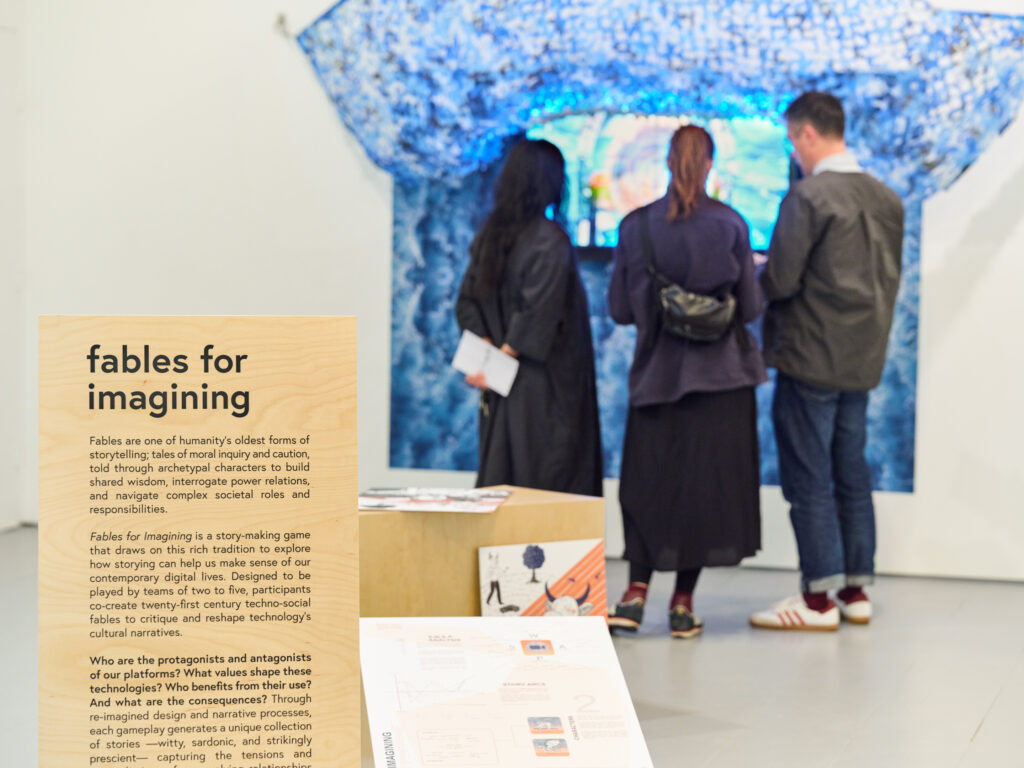
The “Speculating” module expanded the experiment further. Students authored data stories, fabulated alternative futures, and visited the Data Fluencies: Tributaries exhibition at Or Gallery. There, research outputs sat alongside contemporary art, reframing exhibition as a form of research intervention. Inspired by practices such as W. E. B. Du Bois’s data visualizations and feminist data critique, students grappled with the politics of representation and the myth of data objectivity.

The final modules—“Worlding Criticality” and “Undatafying”—asked the hardest questions. How do data produce spaces and publics? How can counterdata serve to challenge hegemonic data infrastructures? When might refusal, opacity, or uncertainty be more responsible approaches to research rather than collecting more data? Through mapping exercises, scenario building, and speculative prototyping, students composed research actions rather than static research designs: public interventions, co-design workshops, artifacts, essays, and multimodal explorations.

The pilot culminated in a capstone crit. Instead of submitting conventional research proposals, students presented composed research actions—interventions that reframed their own graduate projects. An annotated portfolio, generated by each student, documented not just outcomes but processes, doubts, and transformations.

By the end of the pilot, the experiment had generated more than assignments. It produced a cohort fluent in moving between formats and senses, between critique and making, between analysis and action. The pilot demonstrated that teaching data fluencies is less about adding technical skills or memorizing a discipline’s epistemological commonplaces and more about collectively engaging with others in acts of composition, critique, participation, speculation, and care.
TILT

Teaching and Learning Data Fluencies as Research Practice (TLDF) is a Scholarship of Teaching and Learning (SoTL) initiative supported by SFU’s Transforming Inquiry into Learning and Teaching (TILT) unit. The project was designed to investigate how scholars develop and apply data fluencies as part of their teaching within the context of the School of Data Fluencies’ first Instance.

Moving beyond conventional notions of data literacy, data fluencies is conceptualized as a hybrid competency that integrates interpretive traditions from the arts and humanities with critical and technical approaches from the data sciences. The overarching aim of this first Instance was to equip doctoral students and early career researchers with the conceptual, methodological, and practical tools needed to develop data fluencies to engage creatively and critically with data-intensive environments.

The TLDF project unfolded over several phases. Prior to the Instance itself, the work included a literature review focused on teaching fluency, frameworks for assessing interdisciplinary research skills, and the co-development of digital platforms to support annotated portfolios and narrative mapping. The SoTL component of TLDF focused on the delivery of the SDF Pilot Instance to better understand whether participants developed data fluencies and how they integrated these skills into their own research trajectories. The project was guided by four primary research questions:

  1. How do participants’ conceptions of data fluencies change over the course of the program and how are these conceptions operationalized as part of their research practices?
  2. Do participants move beyond traditional models of disciplinary knowledge acquisition toward cultivating broader interdisciplinary attitudes and habits?
  3. To what extent does the program facilitate the development of professional networks among participants, mentors, and collaborators?
  4. Finally, how do participants disseminate the work generated through their participation? (including the platforms and channels they deem most appropriate for communicating data fluencies practices)

Methodologically, data collection for the TLDF centered on several complementary instruments. Participants completed an annotated portfolio documenting their learning processes, including engagement with preparatory materials and activities undertaken during the Instance. This portfolio included a pre-test/post-test design that captured shifts in participants’ understanding of interdisciplinary research and data fluencies at early and latter stages of the Instance. In addition, participants produced a final research paper that involved the application of data fluencies. Data analysis relied on two rounds of thematic analysis: the first using a grounded approach to understand how students gave meaning to the role of data in their research in practice; the second round to see how these meaningful associations fit within an overall articulation of a research ‘problem space’ (Lury 2021). Comparative analysis was used to assess changes over time, particularly in relation to pre- and post-test responses.

Findings will inform subsequent SDF Instances, enabling a cumulative and iterative refinement of both the training program and its assessment strategies. The TLDF will be used to support the development and evaluation of future Instances as a structured training program in the hopes that insights gained from the investigation will assist in the development and implementation of the School of Data Fluencies. Ultimately, the project contributes to both pedagogical practice and scholarly discourse by developing robust frameworks for teaching and assessing data fluencies as a form of interdisciplinary research practice.

Reference

Lury, C. (2021). Problem Spaces: How and Why Methodology Matters. Polity.

Instances

A. Pilot

Simon Fraser University (2025)
Dr. Frédérik Lesage, Prof. Wendy Hui Kyong Chun, and Dr. Gillian Russell 

B. The Digital Narratives Studio, Chinese University of Hong Kong

Dr. Nishant Shah

C. University of Applied Arts, Vienna /Technische Universität Dresden 

Prof. Clemens Apprich and Prof. Orit Halpern 

D. University of Southern California

Prof. Tara McPherson and Prof. Holly Willis 

E. York University / Toronto Metropolitan University

Dr. Ganaele Langlois and Dr. Alberto Lusoli 

F. McGill University / University of British Columbia

Dr. Taylor Owen, Dr. Heidi Tworek, and Dr. Sonja Solomun

G. Simon Fraser University

Dr. Frédérik Lesage, Prof. Wendy Hui Kyong Chun

Get in touch!

Dr. Frédérik Lesage

Simon Fraser University